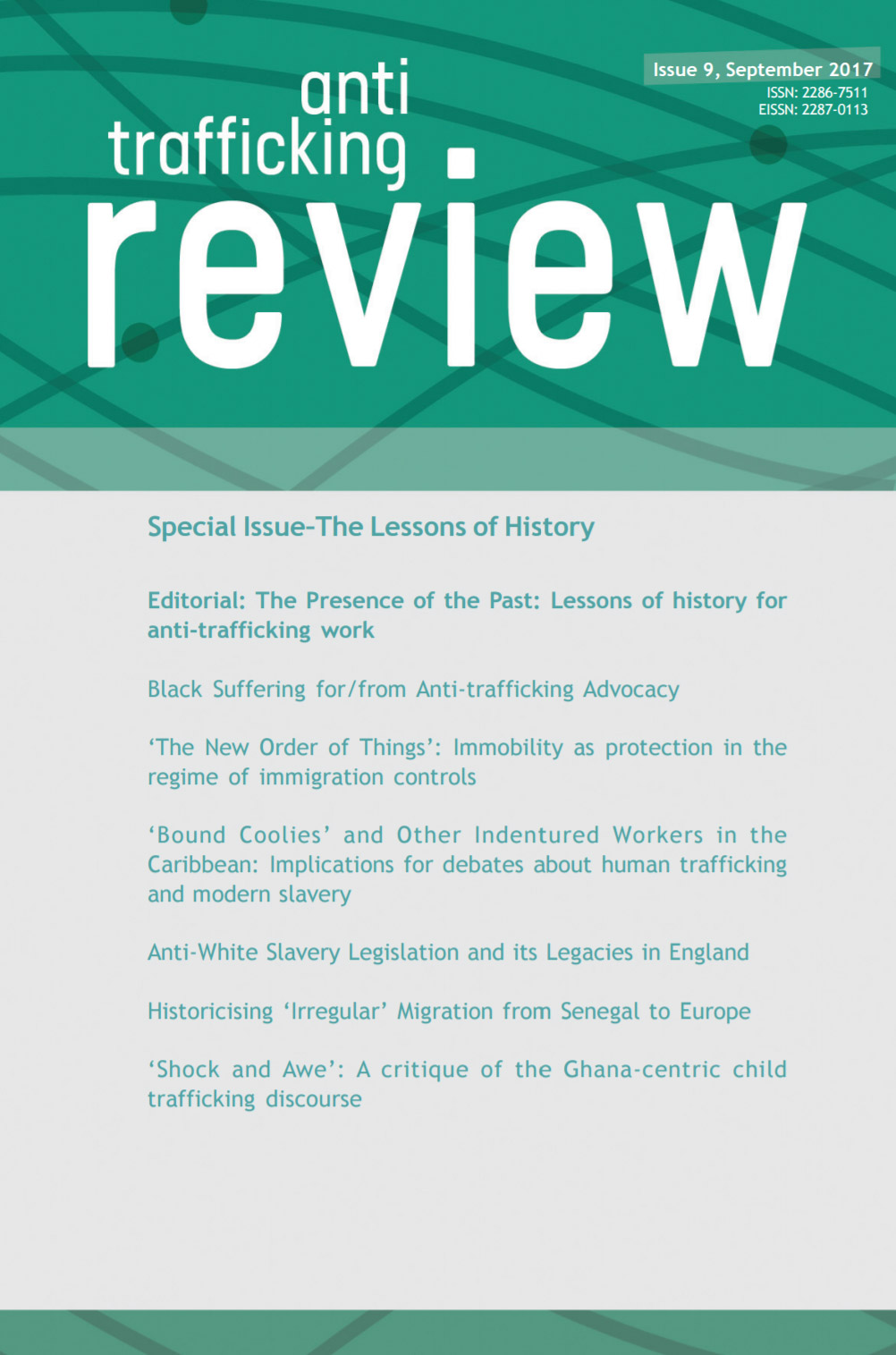
Editorial: The Presence of the Past: Lessons of history for anti-trafficking work
DOI:
https://doi.org/10.14197/atr.20121791Abstract
This issue of the Anti-Trafficking Review is concerned with some of the histories that created, and that continue to shape, both the present-day phenomena discussed under the rubric of trafficking, and the contemporary discourse of trafficking itself. One such history is that of transatlantic slavery. Since the millennium, numerous NGOs have been founded in the US, Australia and Europe with a mission to end what they call ‘modern slavery’. Their campaigns have overlapped with, and played a significant role in shaping, the development of media, NGO, policy and political discourse on human trafficking, which is, according to the antislavery NGO Free the Slaves, ‘the modern day slave trade—the process of enslaving a person’.1 In this discourse, the history of transatlantic slavery is invoked by means of visual as well as textual references in order to emphasise the severity of trafficking (and other phenomena included under the umbrella of ‘modern slavery’) as a human rights violation. The message has been communicated so effectively that although in international law slavery is held to be only one of several possible outcomes of trafficking, in the anti-trafficking rhetoric emanating from national and international policy agencies, as well as NGOs, trafficking is now frequently said to be ‘modern slavery’.2
Metrics
Published
How to Cite
Issue
Section
License
Copyright (c) 2017 Julia O’Connell Davidson

This work is licensed under a Creative Commons Attribution 4.0 International License.
Under this license, the public is free to share, adapt, and make commercial use of the work. To protect our work and that of our authors, however, users must always give proper attribution to the author(s) and the Anti-Trafficking Review (i.e. with a complete bibliographic citation and link to the Anti-Trafficking Review website and/or DOI).