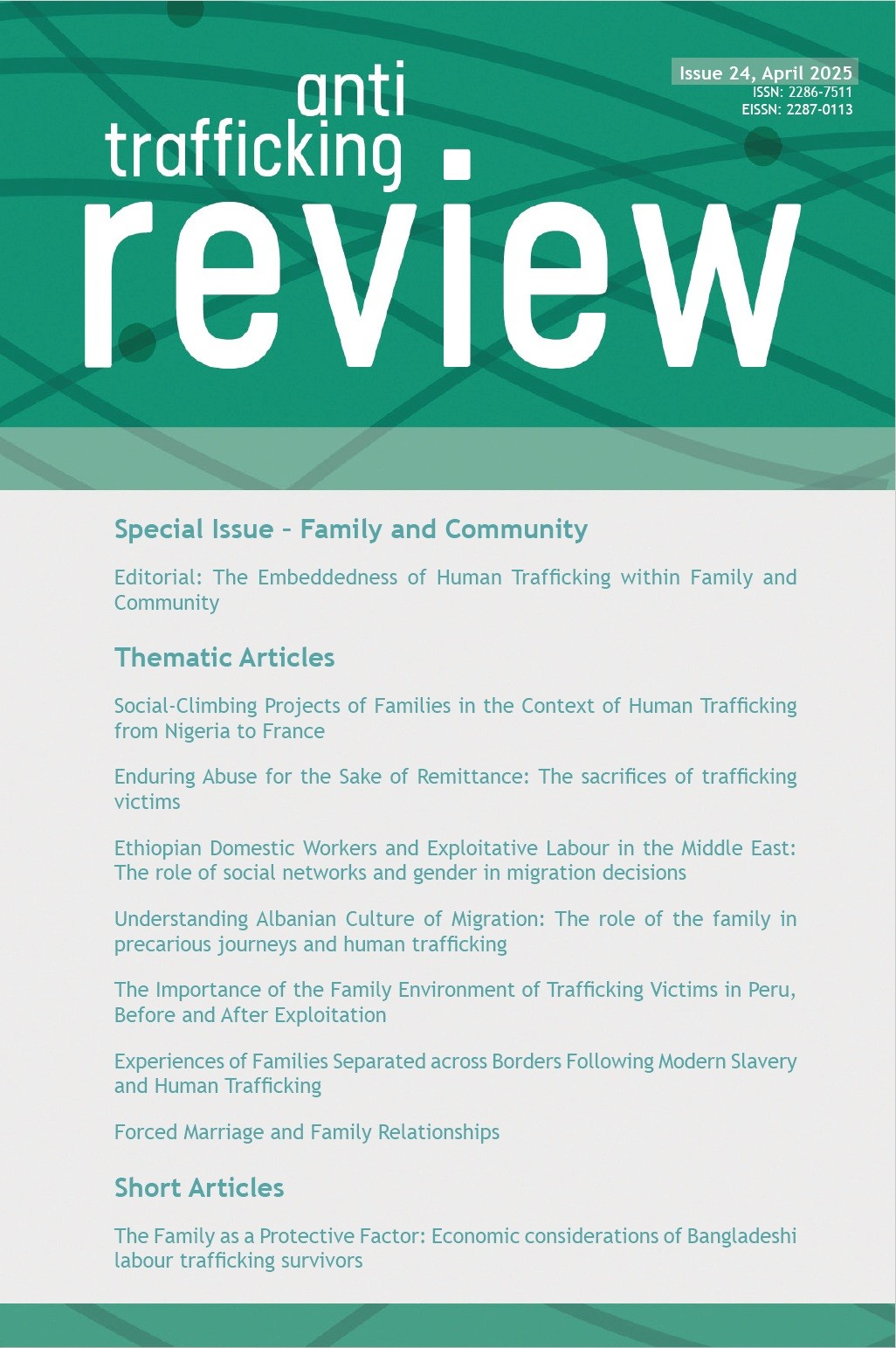
Editorial: The Embeddedness of Human Trafficking within Family and Community
DOI:
https://doi.org/10.14197/atr.201225241Abstract
Family and community play varied and important roles in facilitating human trafficking and helping victim-survivors recover from it. Despite this, many trafficking studies are individualistic in nature and do not consider the broader positioning of victim-survivors within complex social, family, and community structures. The discussion in this Editorial to a special issue of Anti-Trafficking Review provides an overview of the myriads of ways that family and community are central to trafficking. From the recruitment stage through to the recovery stage, the role of family in trafficking cannot be overlooked. In addition, trafficking has such a profound impact on family members, and in particular dependant children, that they should also be considered victims of this crime. The aim of this Editorial is to demonstrate that human trafficking is embedded within family and community and cannot be understood without studying the relational components that define it. It argues that to effectively respond to trafficking, the intergenerational impacts must be considered and holistic family-centric responses developed.
Metrics
Published
How to Cite
Issue
Section
License
Copyright (c) 2025 Nerida Veale

This work is licensed under a Creative Commons Attribution 4.0 International License.
Under this license, the public is free to share, adapt, and make commercial use of the work. To protect our work and that of our authors, however, users must always give proper attribution to the author(s) and the Anti-Trafficking Review (i.e. with a complete bibliographic citation and link to the Anti-Trafficking Review website and/or DOI).