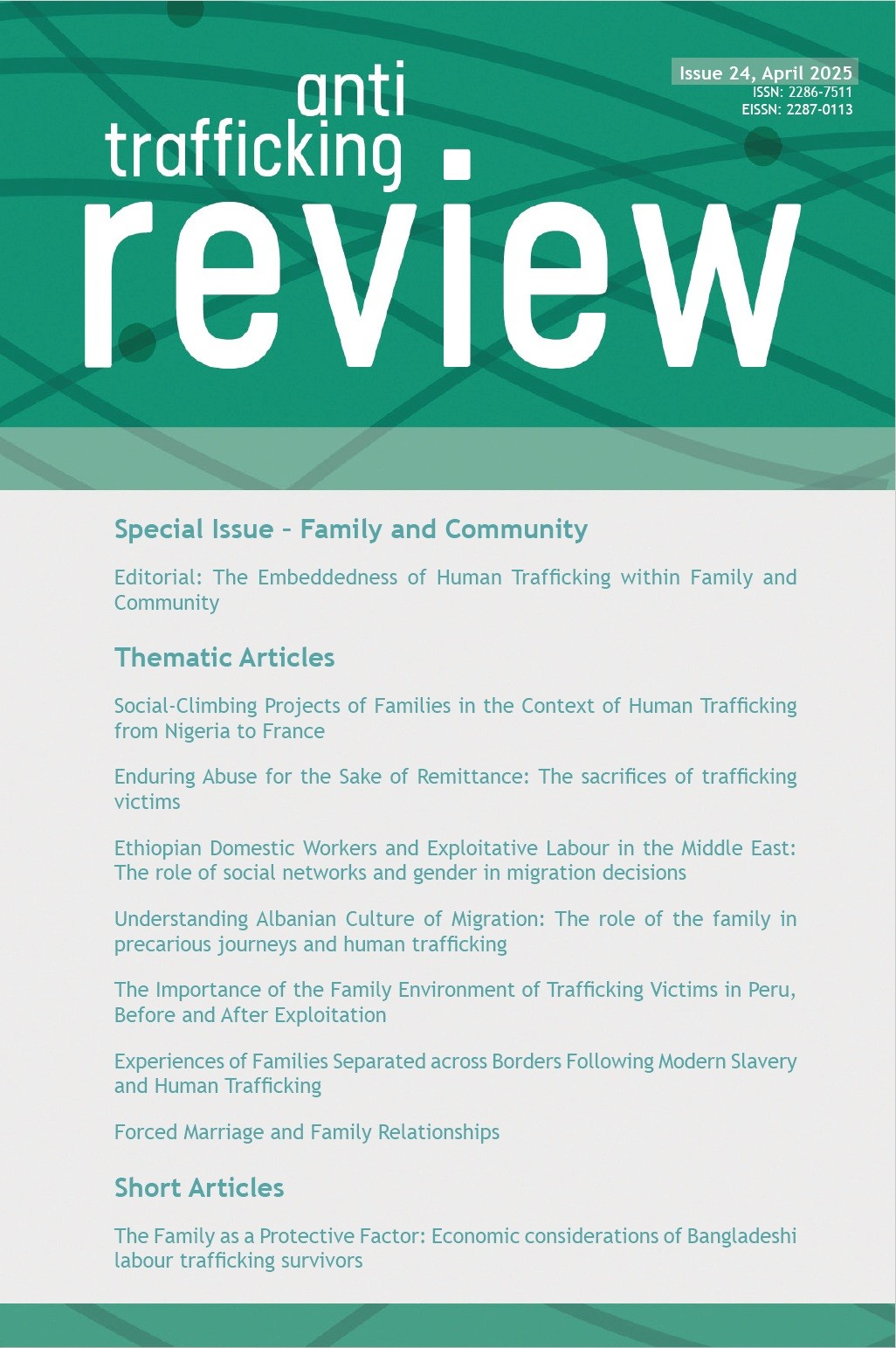
The Importance of the Family Environment of Trafficking Victims in Peru, Before and After Exploitation
DOI:
https://doi.org/10.14197/atr.201225246Keywords:
human trafficking, family, Peru, access to justice, protection, vulnerability, revictimisation, reintegrationAbstract
This article analyses the importance of the family environment of victims of human trafficking in Peru, before and after exploitation. Based on interviews with 30 victims and 10 family members, it demonstrates that families, primarily mothers, can play a powerful role in both preventing victimisation and assisting victims to recover from human trafficking experiences. Family structure and background can increase victims’ vulnerability, yet the families are also the ones that protect and take care of victims. However, government officials often blame parents and family members for victims’ exploitation, leading to revictimisation of both victims and their families. Understanding families’ role in victim reintegration is crucial for improving the quality of social inclusion. Protection and care services workers must involve victims’ families as part of their recovery process and receive further training to safeguard survivors’ physical and mental integrity.
Metrics
Downloads
Published
How to Cite
Issue
Section
License
Copyright (c) 2025 Andrea Querol, Antonia Lerner

This work is licensed under a Creative Commons Attribution 4.0 International License.
Under this license, the public is free to share, adapt, and make commercial use of the work. To protect our work and that of our authors, however, users must always give proper attribution to the author(s) and the Anti-Trafficking Review (i.e. with a complete bibliographic citation and link to the Anti-Trafficking Review website and/or DOI).