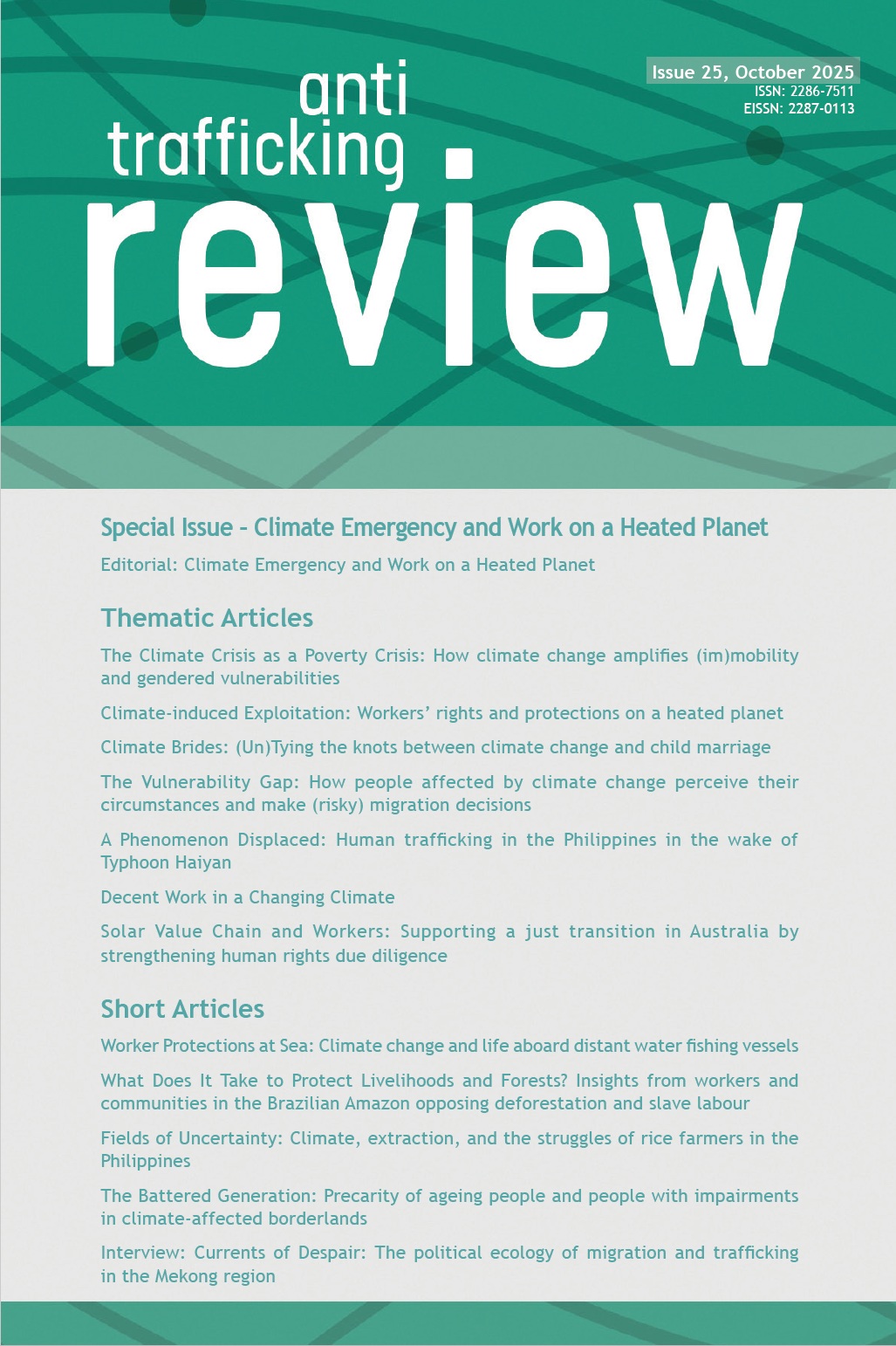
A Phenomenon Displaced: Human trafficking in the Philippines in the wake of Typhoon Haiyan
DOI:
https://doi.org/10.14197/atr.201225256Keywords:
human trafficking, disaster, Typhoon Haiyan, Super Typhoon Yolanda, PhilippinesAbstract
Widespread claims about human trafficking emerge after many climate-induced disasters, with news headlines about children being snatched, abducted, and exploited. One such example is Typhoon Haiyan (Yolanda) which struck the Philippines in 2013, partially destroying Tacloban City and claiming more than 6,000 lives. Returning to the city after this historic storm, I conducted interviews with professionals who were likely to have encountered trafficking cases, including police, government anti-trafficking officials, NGO workers, community leaders, academics, and judges. However, despite widespread claims of post-disaster trafficking, only four cases were ever investigated—none of which resulted in prosecution. Casting the net wider, I discovered that affected people living in more peripheral areas, or who were displaced there, appeared more likely to be recruited into trafficking than those at the geographical centre of the disaster. In an area of study almost completely devoid of empirical evidence, this paper challenges an assumed direct link between disasters and trafficking. It presents a more nuanced picture of a multi-step process in which disasters destroy livelihoods, prompting a precarious search for work which can, in turn, heighten the risk of human trafficking.
Metrics
Published
How to Cite
Issue
Section
License
Copyright (c) 2025 Chris Weeks

This work is licensed under a Creative Commons Attribution 4.0 International License.
Under this license, the public is free to share, adapt, and make commercial use of the work. To protect our work and that of our authors, however, users must always give proper attribution to the author(s) and the Anti-Trafficking Review (i.e. with a complete bibliographic citation and link to the Anti-Trafficking Review website and/or DOI).