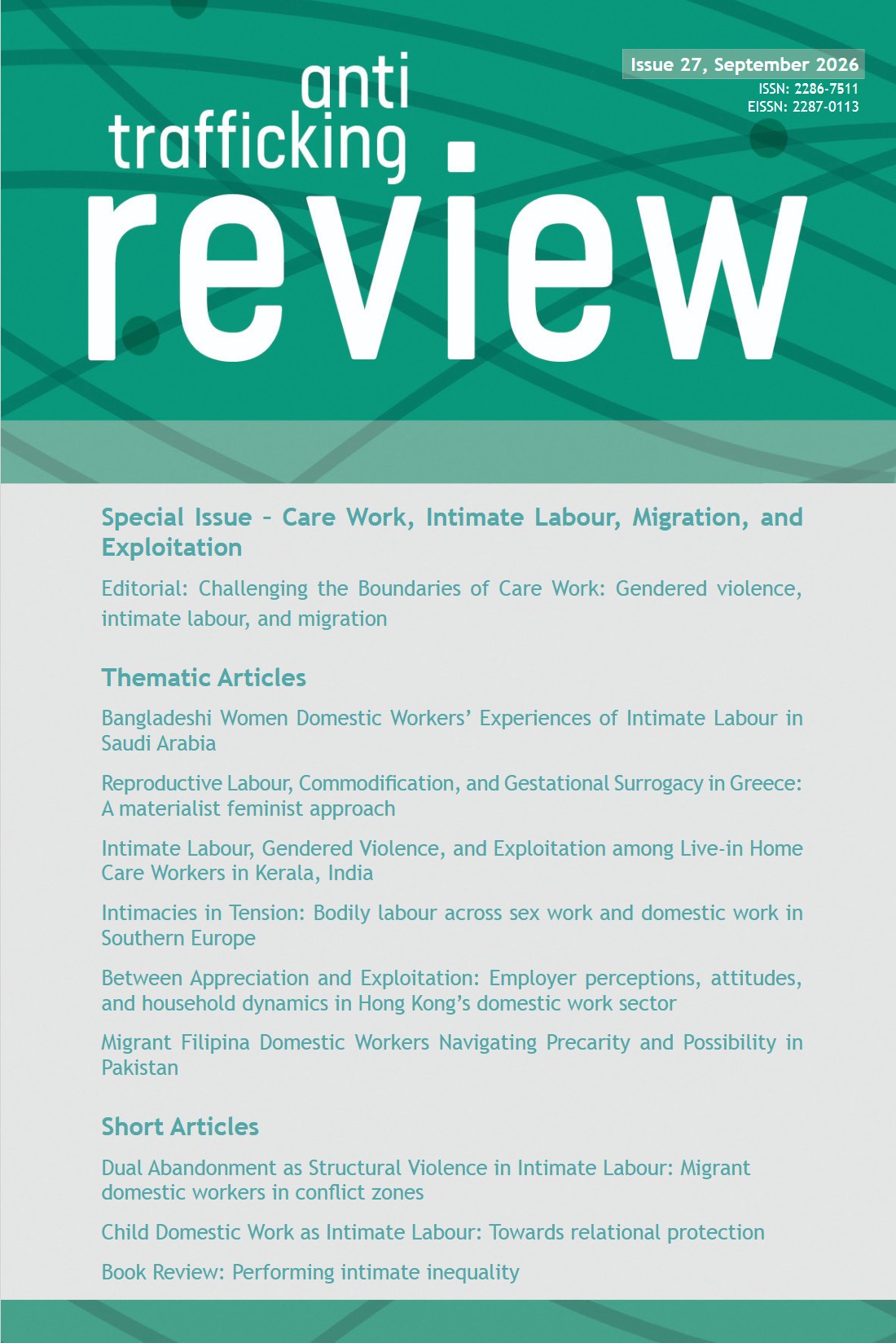
Migrant Filipina Domestic Workers Navigating Precarity and Possibility in Pakistan
DOI:
https://doi.org/10.14197/atr.201226277Keywords:
Pakistan, labour regulation, women’s agency, migrant domestic work, Filipina migrant workers, South-South migration, bilateral labour agreementsAbstract
Rooted in feminist political economy, critical migration theory, and scholarship on intimate labour, this article explores how gendered, racialised, and class hierarchies, recruitment agencies, bilateral labour arrangements, and shifting regulatory frameworks shape migrant Filipina domestic workers’ experiences in Pakistan. Drawing on seven interviews in Islamabad and Lahore, the article asks how intersecting harms linked to labour informality, migration status, employer power, and household intimacy are negotiated through individual and collective agentic practices. It argues that migrant Filipina domestic workers’ experiences cannot be understood through victimhood or empowerment alone. Rather, their lives are shaped by the interplay between structural precarity and situated agency, expressed through migration decisions, employer changes, community networks, religious and familial negotiations, entrepreneurship, and strategies of relative upward mobility. The article concludes with policy and practice implications for labour law recognition, recruitment regulation, improved data collection, migrant women’s associations, and intersectional gender and migration policy.
Metrics
Published
How to Cite
Issue
Section
License
Copyright (c) 2026 Runa Lazzarino, Eleonore Kofman, Sobia Kapadia

This work is licensed under a Creative Commons Attribution 4.0 International License.
Under this license, the public is free to share, adapt, and make commercial use of the work. To protect our work and that of our authors, however, users must always give proper attribution to the author(s) and the Anti-Trafficking Review (i.e. with a complete bibliographic citation and link to the Anti-Trafficking Review website and/or DOI).